
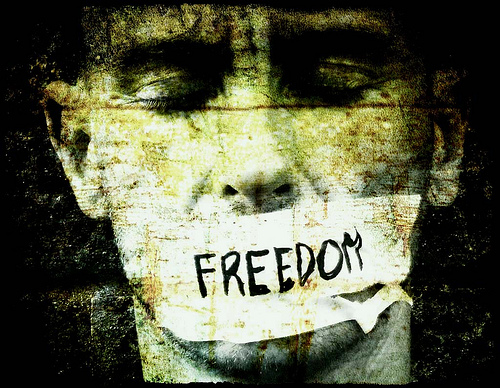
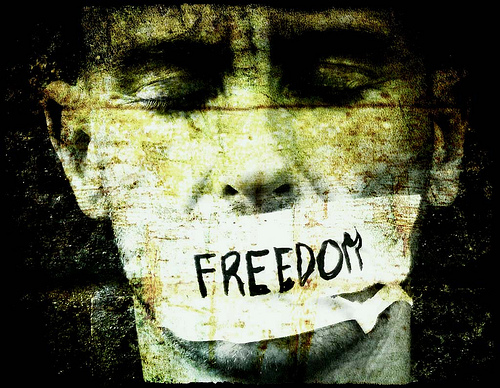
The second half of 2010 saw some great online debates, fights and rants on an individual’s right of expression and limits to it, much fuelled by Arundhati Roy’s controversial essay in Outlook on the Maoist insurgents followed by her even more controversial speech supporting Kashmir separatists that prompted some people to file a case of sedition against her in a Delhi court.
Recently, the debate once again got vocal when columnist Anish Trivedi was sentenced to 6 months’ imprisonment for what he wrote about members of the Dalit community who got jobs from the reservation quota. Some blogged, many more discussed and debated this on Twitter. The nature of the subject is such that debates on this will continue till the time …
Well, will try to reach this at the end.
Coincidentally, completely unrelated to the Anish Trivedi conviction, I had been discussing this with two of my good friends on Twitter – Anand Philip and Ketan Panchal (both young, energetic doctors with interests on a range of subjects) on the limits of free speech.
Should there be any restrictions on free speech, and if so what should be a fair limit?
I strongly believe that freedom of speech, as enshrined in the preamble of the Universal Declaration of Human Rights charter, is one of the basic human rights. Without the freedom of thought, and to be able to express it, human beings would simply be another species.
Also, by allowing ourselves to accept that we have no freedom to question authority, we would only encourage speedier than gradual despotic systems around us just as we saw in the communist regimes in the world, as epitomized by George Orwell’s immortal work – Animal Farm.
A true democracy isn’t so until it allows its citizens to speak their mind freely, where no attempt to control thought is made.
Someone could suggest that with great freedom comes great responsibility, which is a slight deviation from the adage – with great power comes great responsibility (an enhancement of the Biblical quote: “But he that knew not, and did commit things worthy of stripes, shall be beaten with few stripes. For unto whomsoever much is given, of him shall be much required: and to whom men have committed much, of him they will ask the more.” Luke 12:48).
Still valid, but what’s the use of a freedom when we can’t use the full extent of it? It is like you have the right to carry a gun and use it for self defense, but if you use it in public, you would be put in jail because of your thoughtlessness for having used it in public endangering lives of others apart from the attacker. Shall discuss what/who an attacker is in the broader sense later in the post.
Today we are seeing growing intolerance around the world, especially when it comes to expressing views through words or art/illustrations involving religion or religious figures. Blasphemy, hate speech, seditious speech, instigating speech etc have become buzzwords of the day. What’s blasphemy? When religion itself is man-made, why can’t it be questioned, why can’t one disagree with the scriptures? If one disagrees with something, he should be able to express it. There is nothing in the world that is 100% correct.
Similarly, what constitutes a hate speech? If speaking against a certain community, race etc amounts to hate speech, almost all of humankind is guilty of having made such a speech in his life, whether be it in public or private.
There are some greater issues involved in criminalizing public expression of thoughts by branding them as racist, hate speech, blasphemous, seditious etc. Let me first take the issue of Anish Trivedi before I mention a couple of international characters.
Whatever he wrote in his column was his personal view. It was written in English, for a tabloid that wasn’t as big then as it is today. Despite being an avid netizen, I missed reading the article (if ever it was posted online), or heard any buzz around it then. I didn’t know until now! That being a story in itself apart, whatever he wrote was what many millions in India truly feel. A casual banter in a college or office canteen would tell you the truth.
Let me share with you something that I experienced first hand. I have lived in Patna for over a decade and half. One of my school mates, a Rajput by caste (though I thought Rajputs were only Kshatriyas) went to study in the Bihar Veterinary College, which was close to my home. One day, in the mid-1990s he invited me to his hostel where I had lunch with him in the dining mess of the college. I was surprised to see that it was divided along caste lines.
Rajput-Thakurs sat together, Yadavs sat separately and those who got admission through the reservation quota sat entirely separately. They were looked down upon and members of the other so-called upper castes openly despised them. It was rather embarrassing for me to sit through the lunch when some of who I was sitting with were openly mocking them.
It was a shocker.
I could imagine the state of affairs in other professional colleges like the numerous medical and engineering colleges in India’s many states that have a caste problem. By that extension, I could also imagine the discrimination they faced in workplaces etc.
This brings to the question why there is so much angst against those who are entitled to the reservation quota. It is not inherent. It was simply because reservation is used for vote-bank politics. The “creamy layer provisions” are by and large ignored, manipulated or simply not implemented. The benefits of the reservation quota are so great that many agitations were/are fought by members of various communities to include them in the Scheduled Castes or Schedule Tribes category that enjoy automatic reservation, or merely to extend reservation to their communities.
We saw one very recently.
This has resulted in many mediocre professionals getting inducted in prestigious educational institutions, PSUs etc while meritorious and deserving candidates were left out. Therefore, the buzz is that those who got a job without having to toil that hard and without sufficient merit have brought with them a culture of inefficiency, laziness, unprofessional work ethics etc. This thought has gained currency among a sizeable number of Indians that manifested itself in Anish Trivedi’s article.
I, however, find this kind of generalization as incredibly unfair and immoral.
But, we are not talking about morality here. What type of a country would impose restrictions on a fundamental human right based upon morality? A look around would suggest that those countries with the most abysmal of human rights records do that. And, not surprisingly most of these countries are run by tyrants of the worst kind. Imagine a country that executes people for “thought crimes”.
So, what happens in those countries where you cannot vent out your frustrations, anger etc in form of words, art or illustrations in public even if they contain profanity? The frustrations, the energy get into underground channels, and they find agreeing whispers. Accumulation of this energy often turns into a bad movement because there are always people with nefarious agenda ready to mislead and brainwash.
It is easy then.
Ayman al-Zawahiri’s Egyptian Islamic Jihad is an example of this. The Iranian Revolution happened mainly because of the way the Shah dealt with his subjects. Saudi Arabia is too feeling the heat of an underground movement that wishes to overthrow the House of Saud from power.
When Arjun Singh, the human resource development minister in UPA-I increased the quota in educational institutions, young students under the leadership of what looked like teachers protested in the Delhi Metro trains. They were chanting slogans like – “Arjun Singh ka bhai kaisa ho? Praveen Mahajan jaisa ho!” [Roughly translated – How should Arjun Singh’s brother be? He should be like Praveen Mahajan (who shot dead his brother Promod)]. This happened right in the heart of the capital and yours truly was witness to it.
Why wasn’t anyone arrested or tried for this? Given the implications, they were calling for the death of man who tried to extend the reservation quota, and by extension against the people who enjoy it as their birth right without having to do as much to earn it as the “general” category members do.
The “attacker” as I mentioned earlier in the article could be one who demands and gets reservation just as he could be the one who uses slur against them to drive a point. An attacker could be the buccaneers of a faith, an authority, the government etc. It all depends on how you perceive an attacker from a victim.
And, since it is a subject to perception of an individual, one doesn’t have the right to infringe upon the right of an individual of free speech.
Unlike India, most Western societies understand this broadly. Therefore, we see tolerance for people like Pastor Terry Jones, Glen Spicer, Louis Farrakhan, Kurt Westergaardetc. Having said that, we must not lose the perspective that freedom of speech is not entitlement to be heard.
Therefore, are all types of speeches non-criminal in nature then? The answer is NO. Some definitely fall under the category of criminal use of speech. However, they are extremely few in my opinion. Two possibilities come to my mind at this moment that can be categorized as criminal, though I yield that they can be challenged as well.
- To instigate an emotionally charged and volatile mob that has gathered in order to protest against a gruesome crime to kill or riot
- To demoralize soldiers in the battlefield by telling them they face sure defeat and/or this isn’t a just enough cause to fight
As I stated in my opening paragraph, I would try to reach the end of this never-ending debate. Well, the nature of the subject is such that debates on this will continue till the time bigotry is completely defeated and eradicated from this world.
Comments are closed.